
Learn Torque and Equilibrium with an Interactive 3D Physics Simulator
Explore torque, support reactions and pulleys in the Luce physics simulator, with worked solutions and a study routine for exam preparation.
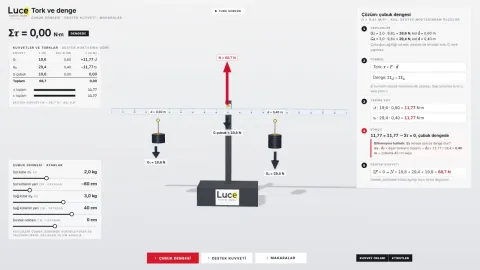
Knowing a formula is only part of solving a torque problem. You also need to picture the turning direction, choose the right distance and understand what happens when a support moves. Luce’s Torque, Equilibrium and Pulleys Simulator lets you test those relationships in an interactive scene.
Move masses, reposition supports and compare ideal pulley arrangements. A solution panel updates the given values, formulas, calculations and checks alongside each experiment. The accompanying lesson also supports Turkish YKS/AYT physics preparation.
Try the torque and equilibrium simulator →
Three experiments, three connected ideas
Beam balance: does the heavier side always go down?
A heavier mass can balance a lighter one if it is closer to the pivot. Compare the products of weight and perpendicular lever arm, rather than mass alone.
With a central pivot, place 2 kg at 60 cm and 3 kg at 40 cm on opposite sides. The torques match: 2 × g × 0.60 = 3 × g × 0.40. Move one mass outward and observe the net torque and turning tendency.
Support reactions: which support carries the load?
Move a load along the two-support beam. As it approaches one support, the share carried by each support changes. The simulated scales make that relationship visible.
The worked solution takes moments about one support to find the other reaction, then applies vertical force balance. Moving the load beyond a support also helps illustrate loss of contact and the tipping threshold.
Pulleys: what changes when less force is needed?
Compare a fixed pulley, a movable pulley and a tackle with the same load. In an ideal arrangement, more rope segments supporting the moving assembly mean a smaller pulling force. The trade-off is pulling more rope for the same rise.
For example, four supporting segments lift a 200 N load by 0.50 m with a 50 N pull through 2 m. Input work and the gain in potential energy are both 100 J. A force advantage is not a work advantage.
Connect the formulas to what you see
Torque magnitude is τ = F · d, where d is the perpendicular distance from the pivot to the force’s line of action. For an angled force, the same relationship is τ = F · r · sin θ.
Static equilibrium requires both zero net force and zero net torque. Below the simulator, the lesson provides worked examples, unit conversions and short practice questions. Pulley models are ideal and the simulator uses g = 9.81 m/s². Use the value specified in an exam question if it differs.
A useful study routine
- Predict first. Which side will move down when you move a mass away from the pivot?
- Change one variable. Keep mass fixed while changing distance, then keep distance fixed while changing mass.
- Calculate independently. Draw the forces and mark the perpendicular distances.
- Compare with the solution panel. Identify whether a mistake involves force, distance, direction or units.
- Try another problem. Apply the relationship to a different arrangement in your textbook.
The simulator provides visual support for problem solving. On phones, landscape orientation and full screen make the controls easier to inspect.
Open the experiments and detailed lesson →
Explore more simulations
The Luce simulator library groups experiences into Education and Machines. Explore the physics experiment in Education, or investigate camera settings and components in Machines.
If you need a simulator tailored to your goals, we can define its scope together. Contact us.