
Will AI End Graphic Design?
AI can generate visuals in seconds, so do we still need graphic designers? Here is why human emotion, deliberate choices and brand intuition remain essential in design.
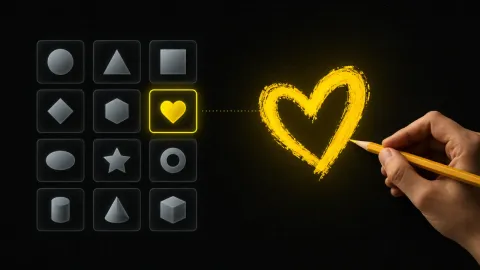
You type a sentence, and a few seconds later dozens of logos, posters or social media visuals appear on your screen. With AI image tools this fast and accessible, the question is a natural one: will AI end graphic design?
The short answer is no. But it is permanently changing how graphic design is done. In this article we look at what has changed, what has not, and why design still needs human emotion.
What does AI genuinely do well in design?
It would be a mistake to underestimate AI's strengths. Today it significantly speeds up several parts of the design process:
- Early concepts: Exploring dozens of visual directions for a campaign takes minutes.
- Variations: Producing versions of the same design in different sizes, colours and formats is much quicker.
- Technical retouching: Time-consuming jobs such as removing backgrounds, extending images and upscaling now take a few clicks.
- Inspiration and discovery: It can surface combinations a designer might not have considered and open up new directions.
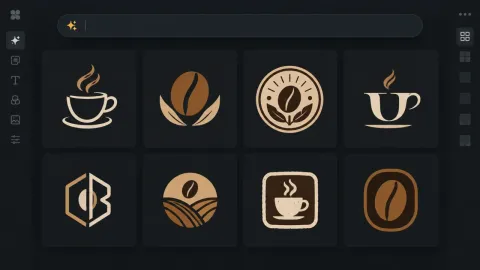
Eight coffee logos from a single prompt. AI makes the concept stage remarkably fast, but deciding which one tells the brand’s story is still a human job.
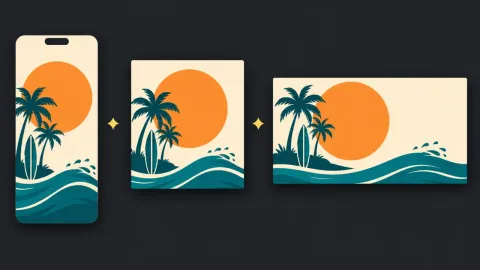
Repetitive work such as adapting one design to story, post and banner sizes now takes seconds.
In other words, AI has become one of the fastest pencils in a designer's hand. But the pencil does not decide what to draw.
The visuals in this article were created with AI and shaped by the Luce team’s choices, so the article itself is an example of the collaboration it describes.
So why isn't it enough on its own?
Design is a decision, not just an image
A good logo is more than an attractive shape. It carries the brand's story, its audience, how it stands apart from competitors and how it will be perceived years from now. AI can produce a "nice" result, but choosing the right one requires understanding the brand, the people and the context.
Emotion is data you cannot measure
Why a colour feels warm, why white space feels calm, why a typeface inspires trust: these are known through experience, empathy and intuition rather than statistics. AI learns from the average of millions of images; people draw inspiration from a memory, a scent, a sign they once saw on a street corner. Designs that create an emotional connection often come from small, brave choices that sit outside the average.
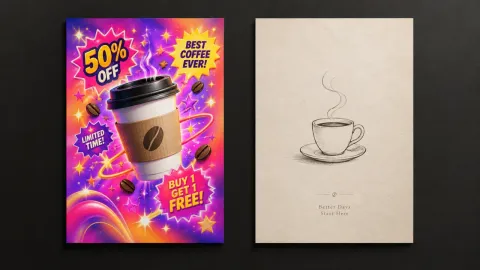
Two posters for the same coffee. The left one shouts everything at once; the right one chooses a single feeling: a calm morning cup. That decision to simplify is a human choice.
Choosing is harder than generating
AI can give you a hundred options. The real work is finding the one that suits your brand, being able to explain why you rejected the rest, and standing behind that choice. Choosing is a responsibility, and that responsibility still belongs to people.
Context and culture matter
A symbol can be positive in one country and negative in another. The timing of a campaign, the public mood, local humour and sensitivities all need to be read by someone who lives in and observes the world.
Originality and brand consistency
AI outputs often look alike. When everyone produces similar visuals with the same tools, looking different becomes even more valuable. Building a recognisable, consistent visual language that is truly yours across every touchpoint requires a deliberate design strategy.
How is the designer's role changing?
A graphic designer is no longer just the person who draws; they are the person who directs, selects and gives meaning. Designers who use AI as an assistant:
- Speed up the concept stage and explore more directions,
- Automate repetitive production work and spend more time on strategy,
- Always leave the final word to the human eye, human taste and the brand's goals.
In short, AI is not replacing designers; designers who use AI well are getting ahead of those who do not.
Conclusion: machines generate, people give meaning
AI is not ending graphic design; it is making it faster, more experimental and more accessible. Yet what makes a design memorable remains the same: human emotion, deliberate choices and a real story.
What makes people love a brand is the presence of people behind it who think, feel and decide. Tools change, but the need to touch the viewer's heart does not. And that touch is still best delivered by a human.
At Luce, we combine the speed of AI with the intuition of a designer's eye. If you want to build an original identity for your brand, explore our Graphic Design service or contact us.